Fitxer:Fourier transform, Fourier series, DTFT, DFT.svg
Salta a la navegació
Salta a la cerca

Mida d'aquesta previsualització PNG del fitxer SVG: 800 × 477 píxels. Altres resolucions: 320 × 191 píxels | 640 × 381 píxels | 1.024 × 610 píxels | 1.280 × 763 píxels | 2.560 × 1.525 píxels | 1.128 × 672 píxels.
Fitxer original (fitxer SVG, nominalment 1.128 × 672 píxels, mida del fitxer: 100 Ko)
Resum
click to expand
This graphic was created with the help of the following Octave script:
graphics_toolkit gnuplot
pkg load signal
%=======================================================
function Y = DFT(y,t,f)
  W = exp(-j*2*pi * t' * f);                    % Nx1 × 1x8N = Nx8N
  Y = abs(y * W);                               % 1xN × Nx8N = 1x8N
% Y(1)  = SUM(n=1,2,...,N): { e^(-B × t(n)^2) × e^(-j2p ×-4096/8N × t(n)) }
% Y(2)  = SUM(n=1,2,...,N): { e^(-B × t(n)^2) × e^(-j2p ×-4095/8N × t(n)) }
% Y(8N) = SUM(n=1,2,...,N): { e^(-B × t(n)^2) × e^(-j2p × 4095/8N × t(n)) }
  Y = Y/max(Y);
endfunction

  T = 1;                             % time resolution (arbitrary)
  Nyquist = 1/T;                     % Nyquist bandwidth
  N = 1024;                          % sample size
  I  = 8;                            % freq interpolation factor
  NI = N*I;                          % number of frequencies in Nyquist bandwidth
  freq_resolution = Nyquist/NI;
  X  = (-NI/2 : NI/2 -1);            % center the frequencies at the origin
  freqs = X * freq_resolution;       % actual frequencies to be sampled and plotted

% (https://octave.org/doc/v4.2.1/Graphics-Object-Properties.html#Graphics-Object-Properties)
  set(0, "DefaultAxesXlim",[min(freqs) max(freqs)])
  set(0, "DefaultAxesYlim",[0 1.05])
  set(0, "DefaultAxesXtick",[0])
  set(0, "DefaultAxesYtick",[])
% set(0, "DefaultAxesXlabel","frequency")
  set(0, "DefaultAxesYlabel","amplitude")

#{
Sample a funtion at intervals of T, and display only the Nyquist bandwidth [-0.5/T 0.5/T].
Technically this is just one cycle of a periodic DTFT, but since we can't see the periodicity,
it looks the same as a continuous Fourier transform, provided that the actual bandwidth is
significantly less than the Nyquist bandwidth; i.e. no aliasing.
#}
% We choose the Gaussian function e^{-B (nT)^2}, where B is proportional to bandwidth.
  B = 0.1*Nyquist;
  x = (-N/2 : N/2 -1);              % center the samples at the origin
  t = x*T;                          % actual sample times
  y = exp(-B*t.^2);                 % 1xN  matrix
  Y = DFT(y, t, freqs);             % 1x8N matrix

% Re-sample to reduce the periodicity of the DTFT.  But plot the same frequency range.
  T = 8/3;
  t = x*T;                         % 1xN
  z = exp(-B*t.^2);                % 1xN
  Z = DFT(z, t, freqs);            % 1x8N
%=======================================================
  hfig = figure("position", [1 1 1200 900]);

  x1 = .08;                   % left margin for annotation
  x2 = .02;                   % right margin
  dx = .05;                   % whitespace between plots
  y1 = .08;                   % bottom margin
  y2 = .08;                   % top margin
  dy = .12;                   % vertical space between rows
  height = (1-y1-y2-dy)/2;    % space allocated for each of 2 rows
  width  = (1-x1-dx-x2)/2;    % space allocated for each of 2 columns
  x_origin1 = x1;
  y_origin1 = 1 -y2 -height;  % position of top row
  y_origin2 = y_origin1 -dy -height;
  x_origin2 = x_origin1 +dx +width;
%=======================================================
% Plot the Fourier transform, S(f)

  subplot("position",[x_origin1 y_origin1 width height])
  area(freqs, Y, "FaceColor", [0 .4 .6])
% xlabel("frequency")            % leave blank for LibreOffice input
%=======================================================
% Plot the DTFT

  subplot("position",[x_origin1 y_origin2 width height])
  area(freqs, Z, "FaceColor", [0 .4 .6])
  xlabel("frequency")
%=======================================================
% Sample S(f) to portray Fourier series coefficients

  subplot("position",[x_origin2 y_origin1 width height])
  stem(freqs(1:128:end), Y(1:128:end), "-", "Color",[0 .4 .6]);
  set(findobj("Type","line"),"Marker","none")
% xlabel("frequency")            % leave blank for LibreOffice input
  box on
%=======================================================
% Sample the DTFT to portray a DFT

  FFT_indices = [32:55]*128+1;
  DFT_indices = [0:31 56:63]*128+1;
  subplot("position",[x_origin2 y_origin2 width height])
  stem(freqs(DFT_indices), Z(DFT_indices), "-", "Color",[0 .4 .6]);
  hold on
  stem(freqs(FFT_indices), Z(FFT_indices), "-", "Color","red");
  set(findobj("Type","line"),"Marker","none")
  xlabel("frequency")
  box on
%=======================================================
% Output (or use the export function on the GNUPlot figure toolbar).
  print(hfig,"-dsvg", "-S1200,800","-color", 'C:\Users\BobK\Fourier transform, Fourier series, DTFT, DFT.svg')
| Descripció |
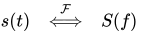
English: A Fourier transform and 3 variations caused by periodic sampling (at interval T) and/or periodic summation (at interval P) of the underlying time-domain function.
Note that only the top left graph is an actual Fourier transform. The others may be related to some limit of the Fourier transform of something as it evolves toward something, but are not Fourier transforms themselves. The graph in the upper right shows the coefficients of the Fourier series for the periodic summation of s(t). The graph at the lower left is the Fourier series whose coefficients are the samples of the function s(t). In the graph at the lower right, the portion labeled "FFT" shows coefficeints for a Fourier series which reproduces samples of the periodic summation of s(t). "FFT" indicates that these coefficients can be found by the "Fast Fourier transform if the values of the periodic summation of s(t) are known at the needed values of t. |
|||
| Data | ||||
| Font | Treball propi | |||
| Autor | Bob K | |||
| Permís (Com reutilitzar aquest fitxer) |
Jo, el titular dels drets d'autor d'aquest treball, el public sota la següent llicència:
|
|||
| Altres versions |
This file was derived from: |
|||
| SVG genesis | ||||
| SVG genesis |


}}
LaTex
![{\displaystyle S[k]\quad S(f)\quad S_{1/T}(f)\quad S_{N}[k]\quad 1/P\quad 1/T\,}](https://wikimedia.org/api/rest_v1/media/math/render/svg/4fae00c04bcc850e64d64732eb19c70ceecbd823)


Historial del fitxer
Cliqueu una data/hora per veure el fitxer tal com era aleshores.
| Data/hora | Miniatura | Dimensions | Usuari/a | Comentari | |
|---|---|---|---|---|---|
| actual | 14:59, 18 set 2024 | | 1.128 × 672 (100 Ko) | wikimediacommons>Bob K | added detail to labels |
Ús del fitxer
La pàgina següent utilitza aquest fitxer:
