Fitxer:Thermally Agitated Molecule.gif
Salta a la navegació
Salta a la cerca
No hi ha cap versió amb una resolució més gran.
Thermally_Agitated_Molecule.gif (280 × 280 píxels, mida del fitxer: 158 Ko, tipus MIME: image/gif, en bucle, 28 fotogrames, 1,1 s)

Resum
| Descripció |
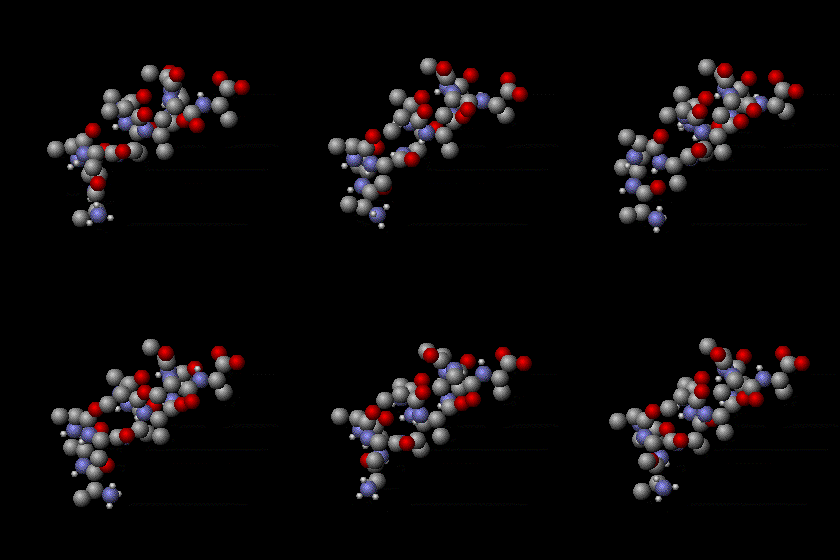
English: Shown here is the thermal motion of a segment of protein alpha helix. Molecules have various internal vibrational and rotational degrees of freedom. This is because molecules are complex objects; they are a population of atoms that can move about within a molecule in different ways. This makes molecules distinct from the noble gases such as helium and argon, which are monatomic (consisting of individual atoms). Heat energy is stored in molecules’ internal motions which gives them an internal temperature. Even though these motions are called “internal,” the external portions of molecules still move—rather like the jiggling of a water balloon.
Afrikaans: Hier word die termiese beweging van 'n segment van proteïen alfa-heliks getoon. Molekules het verskeie interne vibrasie- en rotasievryheidsgrade. Dit is omdat molekules komplekse voorwerpe is; hulle is 'n populasie van atome wat op verskillende maniere binne 'n molekule kan beweeg. Dit onderskei molekules van die edelgasse soos helium en argon, wat monatomies is (bestaande uit individuele atome). Hitte-energie word in molekules se interne bewegings gestoor wat hulle 'n interne temperatuur gee. Alhoewel hierdie bewegings "intern" genoem word, beweeg die eksterne gedeeltes van molekules steeds soos die wiebeling van 'n waterballon. |
| Data | |
| Font | www.physics.unlv.edu |
| Autor | User:Greg_L on English wikipedia, uploaded to commons by User:Frokor |

|
This file was selected as the media of the day for 16 March 2015. It was captioned as follows:
English: Shown here is the thermal motion of a segment of protein alpha helix. Molecules have various internal vibrational and rotational degrees of freedom.
Other languages
Čeština: Animace termálního pohybu atomů v segmentu řetězce bílkoviny (proteinu) označovaného jako alfa-šroubovice (helix). Molekuly se pohybují s různými intervaly rotace i vibrace podle příslušného fyzikálního stupně volnosti. English: Shown here is the thermal motion of a segment of protein alpha helix. Molecules have various internal vibrational and rotational degrees of freedom. Русский: Тепловое движение α-пептида. Сложное дрожащее движение атомов, составляющих пептид, случайно. Серые, красные и синие шары обозначают атомы углерода, кислорода и азота, соответственно; маленькие белые шарики представляют атомы водорода. 中文(简体):肽链α螺旋的热运动
|
Llicència
  
|
Aquest fitxer està subjecte a la llicència Creative Commons Reconeixement-CompartirIgual 3.0 No adaptada. Subjecte a l'avís legal. | |
| ||
| Aquest avís de llicència s'ha afegit a aquest fitxer d'acord amb l'actualització de la llicència GFDL. |

|
S'autoritza la còpia, la distribució i la modificació d'aquest document sota els termes de la llicència de documentació lliure GNU versió 1.2 o qualsevol altra versió posterior que publiqui la Free Software Foundation; sense seccions invariants, ni textos de portada, ni textos de contraportada. S'inclou una còpia d'aquesta llicència en la secció titulada GNU Free Documentation License. Subjecte a l'avís legal. |
Historial del fitxer
Cliqueu una data/hora per veure el fitxer tal com era aleshores.
| Data/hora | Miniatura | Dimensions | Usuari/a | Comentari | |
|---|---|---|---|---|---|
| actual | 22:21, 29 gen 2007 | | 280 × 280 (158 Ko) | wikimediacommons>Frokor | {{Information |Description=Shown here is the thermal motion of a segment of protein alpha helix. Molecules have various internal vibrational and rotational degrees of freedom. This is because molecules are complex objects; they are a population of atoms t |
Ús del fitxer
Les 3 pàgines següents utilitzen aquest fitxer:
