Fitxer:Transmission line animation open short2.gif
Salta a la navegació
Salta a la cerca
No hi ha cap versió amb una resolució més gran.
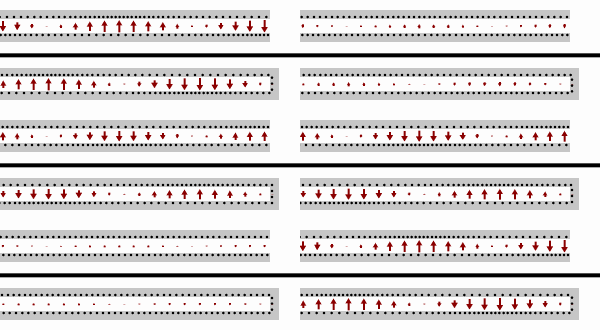
Transmission_line_animation_open_short2.gif (300 × 110 píxels, mida del fitxer: 105 Ko, tipus MIME: image/gif, en bucle, 50 fotogrames, 2,5 s)
Resum
| Descripció |
English: Two transmission lines, the top one terminated at an open-circuit, the bottom terminated at a short circuit. Black dots represent electrons, and the arrows show the electric field. |
| Data | |
| Font | Treball propi |
| Autor | Sbyrnes321 |
| GIF genesis |


Llicència
Jo, el titular dels drets d'autor d'aquest treball, el public sota la següent llicència:
 
|
L'ús d'aquest fitxer és regulat sota les condicions de Creative Commons de CC0 1.0 lliurament al domini públic universal. |
| La persona que ha associat un treball amb aquest document ha dedicat l'obra domini públic, renunciant en tot el món a tots els seus drets de d'autor i a tots els drets legals relacionats que tenia en l'obra, en la mesura permesa per la llei. Podeu copiar, modificar, distribuir i modificar l'obra, fins i tot amb fins comercials, tot sense demanar permís.
|
Source code
"""
(C) Steven Byrnes, 2014-2016. This code is released under the MIT license
http://opensource.org/licenses/MIT

This code runs in Python 2.7 or 3.3. It requires imagemagick to be installed;
that's how it assembles images into animated GIFs.
"""

# Use Python 3 style division: a/b is real division, a//b is integer division
from __future__ import division

import subprocess, os
directory_now = os.path.dirname(os.path.realpath(__file__))

import pygame as pg
from numpy import pi, linspace, cos, sin

frames_in_anim = 50
animation_loop_seconds = 2.5 #time in seconds for animation to loop one cycle

bgcolor = (255,255,255) #background is white
ecolor = (0,0,0) #electrons are black
wire_color = (200,200,200) # wire color is light gray
split_line_color = (0,0,0) #line down the middle is black
arrow_color = (140,0,0) #arrows are red

# pygame draws pixel-art, not smoothed. Therefore I am drawing it
# bigger, then smoothly shrinking it down

img_height = 330
img_width = 900

final_height = 110
final_width = 300

# ~23 megapixel limit for wikipedia animated gifs
assert final_height * final_width * frames_in_anim < 22e6

# transmission line wire length and thickness, and y-coordinate of the top of
# each wire
tl_length = int(img_width * .9)
tl_thickness = 27
tl_open_top_y = 30
tl_open_bot_y = tl_open_top_y + 69
tl_short_top_y = 204
tl_short_bot_y = tl_short_top_y + 69

tl_open_center_y = int((tl_open_top_y + tl_open_bot_y + tl_thickness) / 2)
tl_short_center_y = int((tl_short_top_y + tl_short_bot_y + tl_thickness) / 2)

wavelength = 1.1 * tl_length

e_radius = 4

# dimensions of triangular arrow head (this is for the longest arrows; it's
# scaled down when the arrow is too small)
arrowhead_base = 9
arrowhead_height = 15
# width of the arrow line
arrow_width = 6

# number of electrons spread out over the transmission line (top plus bottom)
num_electrons = 100
# max_e_displacement is defined here as a multiple of the total electron path length
# (roughly twice the width of the image, because we're adding top + bottom)
max_e_displacement = 1/40

num_arrows = 20
max_arrow_halflength = 18

def tup_round(tup):
    """round each element of a tuple to nearest integer"""
    return tuple(int(round(x)) for x in tup)

def draw_arrow(surf, x, tail_y, head_y):
    """
    draw a vertical arrow. Coordinates do not need to be integers
    """
    # calculate dimensions of the triangle; it's scaled down for short arrows
    if abs(head_y - tail_y) >= 1.5 * arrowhead_height:
        h = arrowhead_height
        b = arrowhead_base
    else:
        h = abs(head_y - tail_y) / 1.5
        b = arrowhead_base * h / arrowhead_height

    if tail_y < head_y:
        # downward arrow
        triangle = [tup_round((x, head_y)),
                    tup_round((x - b, head_y - h)),
                    tup_round((x + b, head_y - h))]
        triangle_middle_y = head_y - h/2
    else:
        # upward arrow
        triangle = [tup_round((x, head_y)),
                    tup_round((x - b, head_y + h)),
                    tup_round((x + b, head_y + h))]
        triangle_middle_y = head_y + h/2
    pg.draw.line(surf, arrow_color, tup_round((x, tail_y)),
                 tup_round((x, triangle_middle_y)), arrow_width)
    pg.draw.polygon(surf, arrow_color, triangle, 0)

def e_path_open(param, time):
    """
    "param" is an abstract coordinate that goes from 0 to 1 as the electron
    position goes right across the top wire then left across the bottom wire.
    "time" goes from 0 to 2pi over the course of the animation.
    This returns a dictionary: 'pos' is (x,y), the
    coordinates of the corresponding point on the electron
    dot path; 'displacement' is the displacement of an electron at this point
    relative to its equilibrium position (between -1 and -1); and 'charge' is
    the net charge at this point (between -1 and +1)

    This is for the open-circuit line.
    """
    # d is a vertical offset between the electrons and the wires
    d = e_radius + 2
    # pad is how far to extend the transmission line beyond the image borders
    # (since those electrons may enter the image a bit)
    pad = 36
    path_length = 2 * (tl_length + pad)
    howfar = param * path_length

    #go right along top transmission line
    if howfar < tl_length + pad:
        x = howfar - pad
        y = tl_open_top_y + tl_thickness - d
        displacement = -sin(2 * pi * (tl_length - x) / wavelength) * cos(time)
        charge = cos(2 * pi * (tl_length - x) / wavelength) * cos(time)
        return {'pos':(x,y), 'displacement': displacement, 'charge': charge}

    #go left along bottom transmission line
    x = path_length - howfar - pad
    y = tl_open_bot_y + d
    displacement = -sin(2 * pi * (tl_length - x) / wavelength) * cos(time)
    charge = -cos(2 * pi * (tl_length - x) / wavelength) * cos(time)
    return {'pos':(x,y), 'displacement': displacement, 'charge': charge}

def e_path_short(param, time):
    """Same as e_path_open(...) above, but for the short-circuit line."""
    # d is a vertical offset between the electrons and the wires
    d = e_radius + 2
    # pad is how far to extend the transmission line beyond the image borders
    # (since those electrons may enter the image a bit)
    pad = 36
    path_length = (2 * (tl_length + pad) + 4*d
                   + (tl_short_bot_y - tl_short_top_y - tl_thickness))
    howfar = param * path_length

    #at the beginning, go right along top wire
    if howfar < tl_length + pad:
        x = howfar - pad
        y = tl_short_top_y + tl_thickness - d
        displacement = cos(2 * pi * (tl_length - x) / wavelength) * cos(time)
        charge = sin(2 * pi * (tl_length - x) / wavelength) * cos(time)
        return {'pos':(x,y), 'displacement': displacement, 'charge': charge}

    #at the end, go left along bottom wire
    if (path_length - howfar) < tl_length + pad:
        x = path_length - howfar - pad
        y = tl_short_bot_y + d
        displacement = cos(2 * pi * (tl_length - x) / wavelength) * cos(time)
        charge = -sin(2 * pi * (tl_length - x) / wavelength) * cos(time)
        return {'pos':(x,y), 'displacement': displacement, 'charge': charge}

    #in the middle...
    charge = 0
    displacement = cos(time)

    #top part of short...
    if tl_length + pad < howfar < tl_length + pad + d:
        x = howfar - pad
        y = tl_short_top_y + tl_thickness - d
    #bottom part of short...
    elif tl_length + pad < (path_length - howfar) < tl_length + pad + d:
        x = path_length - howfar - pad
        y = tl_short_bot_y + d
    #vertical part of short...
    else:
        x = tl_length + d
        y = (tl_short_top_y + tl_thickness - d) + ((howfar-pad) - (tl_length + d))
    return {'pos': (x,y), 'displacement': displacement, 'charge': charge}

def e_path(param, time, which):
    return e_path_open(param, time) if which == 'open' else e_path_short(param, time)

def main():
    #Make and save a drawing for each frame
    filename_list = [os.path.join(directory_now, 'temp' + str(n) + '.png')
                         for n in range(frames_in_anim)]

    for frame in range(frames_in_anim):
        time = 2 * pi * frame / frames_in_anim

        #initialize surface
        surf = pg.Surface((img_width,img_height))
        surf.fill(bgcolor);

        #draw transmission line
        pg.draw.rect(surf, wire_color, [0, tl_open_top_y, tl_length, tl_thickness])
        pg.draw.rect(surf, wire_color, [0, tl_open_bot_y, tl_length, tl_thickness])
        pg.draw.rect(surf, wire_color, [0, tl_short_top_y, tl_length, tl_thickness])
        pg.draw.rect(surf, wire_color, [0, tl_short_bot_y, tl_length, tl_thickness])
        pg.draw.rect(surf, wire_color, [tl_length,
                                        tl_short_top_y,
                                        tl_thickness,
                                        tl_short_bot_y - tl_short_top_y + tl_thickness])

        #draw line down the middle
        pg.draw.line(surf,split_line_color, (0,img_height//2),
                     (img_width,img_height//2), 12)

        #draw electrons. Remember, "param" is an abstract coordinate that goes
        #from 0 to 1 as the electron position goes right across the top wire
        #then left across the bottom wire
        equilibrium_params = linspace(0, 1, num=num_electrons)
        for which in ['open', 'short']:
            for eq_param in equilibrium_params:
                temp = e_path(eq_param, time, which)
                param_now = eq_param + max_e_displacement * temp['displacement']
                xy_now = e_path(param_now, time, which)['pos']
                pg.draw.circle(surf, ecolor, tup_round(xy_now), e_radius)

        #draw arrows
        arrow_params = linspace(0, 0.49, num=num_arrows)
        for which in ['open', 'short']:
            center_y = tl_open_center_y if which == 'open' else tl_short_center_y
            for i in range(len(arrow_params)):
                a = arrow_params[i]
                arrow_x = e_path(a, time, which)['pos'][0]
                charge = e_path(a, time, which)['charge']
                head_y = center_y + max_arrow_halflength * charge
                tail_y = center_y - max_arrow_halflength * charge
                draw_arrow(surf, arrow_x, tail_y, head_y)

        #shrink the surface to its final size, and save it
        shrunk_surface = pg.transform.smoothscale(surf, (final_width, final_height))
        pg.image.save(shrunk_surface, filename_list[frame])

    seconds_per_frame = animation_loop_seconds / frames_in_anim
    frame_delay = str(int(seconds_per_frame * 100))
    # Use the "convert" command (part of ImageMagick) to build the animation
    command_list = ['convert', '-delay', frame_delay, '-loop', '0'] + filename_list + ['anim.gif']
    subprocess.call(command_list, cwd=directory_now)
    # Earlier, we saved an image file for each frame of the animation. Now
    # that the animation is assembled, we can (optionally) delete those files
    if True:
        for filename in filename_list:
            os.remove(filename)

main()
Historial del fitxer
Cliqueu una data/hora per veure el fitxer tal com era aleshores.
| Data/hora | Miniatura | Dimensions | Usuari/a | Comentari | |
|---|---|---|---|---|---|
| actual | 03:10, 29 maig 2016 | | 300 × 110 (105 Ko) | wikimediacommons>Sbyrnes321 | all arrows are now red, to reduce image complexity |
Ús del fitxer
La pàgina següent utilitza aquest fitxer:
